


Cold chain and the management of
The cold chain refers to the entire supply chain and includes the production of, Storing and distributing products that need certain levels of temperature control to maintain their characteristics and value.
Cool and cold: What's the Difference;
The cold chain includes storing and distributing products that are chemically and naturally stable based on the following parameters (which should appear on all product packaging).
International Storage and Transportation Requirements:
- Frozen: – 25° and -10° C (-13 and 14° F)
- Cold: Temperatures up to 8° C (46°F)
- Cool: Between 8° and 15° C (46° and 59° F)
- Temperature Controlled: Thermostatics from 20° to 25° C (68° to 77° F)
- Room Temperature: Workplace, uncontrolled
- Hot: 30° and 40° C (86° and 104° F)
- Excessively hot: Above 40° C (104° F)
Although the term cold chain is used to describe products that require special transport conditions, These products are susceptible to all temperature variations. The very cold is as harmful as the very hot! Extra, Many products, Falling into the cold chain category, They are susceptible to changes in humidity and light. It is therefore appropriate to include all sensitive, Changes in conditions, Products in category "Cold Chain 1". This ensures that those items that require special handling, are properly identified and distributed.
Other changes of circumstances to be taken into account, is the altitude. This can easily be overlooked, especially when actors are involved in the supply chain who are external partners, who are unaware of the characteristics of the product
The need for portable recording systems
In large supply chains, For example, many partners involved. Everyone should understand the characteristics of the products they manage. To know their specific requirements and react appropriately in the event of a problem.
This example confirms the need for varying measurements in the movement of cold chain products. The cold chain must be checked and monitored with recordings of the conditions, As the load changes hands. Also, Cargo movement tracking is required as a verification of proper execution. There are tracking and location devices, Record time and location data as the load moves and changes hands.
The temperature and humidity data control and recording systems should provide alerts/alarms in case of deviations of the predefined limits. This is where sensor technology is involved., Which plays a key role in tackling some of the above issues.
Sensors
Temperature monitoring devices are available to confirm proper conditions in storage. Placed in key areas, Monitor and record temperature fluctuations, Humidity and other factors, Which could affect the quality of the products. These devices are used in transport. In a variety of options, To ensure proper management of foodstuffs.
Transfer
Transport service Providers, Storage and Logistics, have special equipment and services designed to improve the refrigeration and freezing of foods requiring special management. In many cases the entire facility is designed for frozen, fresh or other products. They can manage large amounts of food, while ensuring that they are kept at the right temperature. In fact most of the technology that has been developed for the cold chain of logistics, has its roots in the food industry.
Storage
Dedicated storage management systems and technologies have been developed to address the challenges of controlled temperature in storage facilities. Modern technology requires a special consideration when coexisting with the regulations of cold chain storage. The computers were not designed to operate at temperatures below zero and need to be in a protected environment. Printers have problems operating in a humid environment – a phenomenon that occurs in warehouse areas every time doors are opened to place products from the cool in a warmer environment – so it was necessary to take into account adequate operation and technical requirements.
For example, There are many challenges associated with storing in a freezer or in a cooler environment, especially when staff need to keep devices to carry out the project, data collection and updating of storage facility management systems.
Pharmaceutical industry and Life Sciences / Highest product value, Greater Risk
Many of these products are relatively unstable, as they include biological components and other elements that become inactive or contaminated if not properly maintained. Vaccines in particular need to be kept at the right temperature – which is not always an easy task when transporting or administering them to humans or animals, in remote locations. Careful handling of these products is critical, especially since there is a global shortage of certain vaccines – as has recently been proven in the U.S., by distributing flu vaccines as "at risk" products.
The Weak Link in the Cold Chain: Ignoring the "last mile"
These cold chain products, they are literally the lifeblood of healthcare and in many cases have a long production cycle. Years pass, from the initial discovery process, until they reach the clinical trials and final approval of the World Medicines Organization. It has been estimated that every new drug that passes approval has cost literally millions of dollars.
The last mile in the case of these products is the point of consumption, like the hospital, doctor's office or home. There are many horror stories of products that have been carefully stored and transported, only to find its way into a domestic environment, unsuitable according to quality control regulations.
For healthcare products, The use of wireless temperature loggers is necessary, to ensure the quality of medicinal products throughout the life cycle of the product.
Ensuring the integrity and efficacy of medicinal products, has implications beyond the economic. Social issues and the consequences for human health, using a substandard product, cannot be evaluated. Lives at stake!!!
The challenges: 80 millions of loadings biosciences cold chain products, traded globally on an annual basis. And these products concern the following sectors::
- Vaccines and Injectables
- High Value Organic
- Blood Products – including plasma, platelets etc..
- Diagnostic products – including test kits and reagents
- Veterinary Products
- Medical Devices
Cold chain statistics data, concerning the distribution rate of life sciences products, It's hard to find.
Products at risk of extreme cold are:
- Vaccines, insulins, organic products, blood products
- Products that are unstable, E.g. some solutions/emulsions
Products at risk of elevated temperatures are:
- Vaccines, insulins, organic products, blood products
- Chemically unstable products, E.g. chloramphenicol eye drops
- Products naturally unstable
- Semi-solid products, E.g. Suppositories
Conclusion
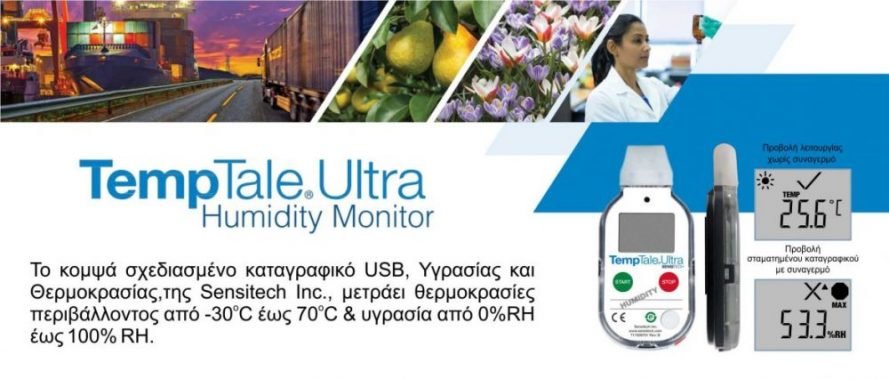
The need to use portable temperature control systems, in the supply chain is great. The EcoHellas.gr has a wide range of temperature and humidity recorders Sensitech Inc., USA, for food, Pharmaceuticals and industry. See here the full range of our products.
Bibliography: COLD CHAINS ARE HOT!
Mastering the Challenges of Temperature-Sensitive Distribution in the Supply Ch