



Short History of Sensitech: Monitoring the Cold Chain 1.0
Food

On 22 June 2020, the Sensitech® will celebrate the anniversary of the 30 years as a leading provider of visibility solutions in the supply chain. Η Sensitech relied on the talent of many people to get to this point – specialists in refrigeration chains, Logistics supply chain, Software, hardware and industrial engineers, together with people with experience and creativity to offer real value to our customers. Thanks to these hardworking and dedicated people, we are here today., Ever since the cold chain started..
We are pleased to begin our celebration with a series of three sections, about the history of cold chain monitoring through the eyes of our guest writer and former CEO of the Sensitech, Eric Schultz. This series will record the history of the cold chain and its vital role Sensitech as a developing, innovative industry leader.
The 1990, New England businessman Sandy Santin founded a support company, combining sensors and technology, who named Sensitech. Santin believed that the monitoring of the cold chain – recording the temperature of food and pharmaceutical shipments as they move around the world – was a mature development in the industry to avoid cracks in the management of. The cost of memory, batteries and electronic assembly, led to the thought that a reusable electronic display, could prove competitive compared to the dominant mechanical recorders with tape.
Thomas Frank “Tf” Ryan
The king of the cold chain surveillance industry in 1990 was Ryan Instruments. The founder of, Thomas Frank “Tf” Ryan, presented the diagrams and invented the concept of cold chain monitoring in the 1980s 1920.
After a decade of competition in which the cold chain monitoring industry added new players and size, Sensitech and Ryan joined in a force. The 2006, Sensitech was acquired by Carrier Corporation, strengthening its technological potential and the global presence of the.
Today, Sensitech offers supply chain visibility services in every major market in the world. But the roots of these sophisticated, services date back more than a century, at a time when the consumption of fresh fruits and vegetables throughout the year was, for most U.S. residents, just a dream.
In 1990, New England entrepreneur Sandy Santin founded a venture-backed startup, a combination of sensors and technology that he called Sensitech.
More Than One Orange
Until the civil war, Americans ate mainly wheat and beef in the North, corn and pork in the South. Fresh produce was limited due to geography and season. "A child who had eaten more than one orange in a whole year", added journalist Mark Sullivan, "was likely to be above average his financial situation and good luck". 1
In the 1980s, 1890, the first attempts were made to send fresh products in refrigerated wagons. Until A ‘?, America had 135.000 Refrigerators, helping quickly to diversify the national diet
One of the Americans responsible for this progress was TF Ryan., who set up the wholesale distribution of fruit in Spokane in 1889. Until A ‘?, Ryan's organization included offices all over the western U.S., a huge banana plantation in Mexico and a thriving production center in Los Angeles. The 1917, TF Ryan was the most widely known fruit wholesaler in America.
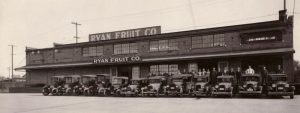
Η Warehouse of the Ryan Fruit Company Warehouse; Source: ©1927 Charles Libby Collection, Northwest Museum of Arts & Culture, Spokane Washington
A Category Only
Industrial refrigeration wagons will not be marketed until the 1980s 1950. Before that time, the secret to successfully sending TF Ryan products was ice. For shipments from California to the East Coast, railway workers to renew the ice in each wagon up to nine times from the grower to the distributor.
They couldn't trust all the railroad employees., To be sure of the ice renewal in Ryan's wagons.. Sometimes, the company's sensitive cargo had been subjected to excessive heat for large parts of its journey.3 In response, The 1919 TF acquired a "thermostat" from inventor Welch Barstow that included a bimetallic coil that would expand and contract with temperature changes.4 This coil became the "secret sauce" in the temperature recorder with ryan and barstow tape.
The first 970 with springs, metal recorders were constructed in 1923 and began to accompany the refrigerated wagons – Probably full of bananas going from Mexico to Seattle. – to provide information for the producer, receiver and railroad.
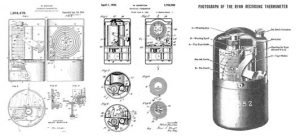
Source: patents.google.com
The Evolution
TF Ryan died in 1942. Five years later., his widow, commissioned a study of the recording industry at Booz Allen & Hamilton to determine the prospects of its company, With taped temperature records. Until then., The Ryan Recording Thermometer Company had two employees, three competitors, 1.470 temperature recorders with strips and served customers, with frozen food, perishable fresh food, Flour, cosmetics and film.
Ο Booz Allen, had written that, ryan's small durable and reliable product, is a category in itself. The consultants also noted that the demand for temperature monitoring, expected to increase because, The customers told them, "the conditions that led us to the need to record temperatures in the past will continue to exist, to a more pronounced degree, in the future”. 5 …And little did they know at the time...
Next: Brief History of Sensitech: Monitoring the Cold Chain 2.0

The Eric B. Schultz Is The Former Ceo of the Sensitech Inc.. The New of the Book Is “Innovation on Tap: Stories of Entrepreneurship from the Cotton Gin to Broadway’s Hamilton”.
- Mark Sullivan, Our Times: The United States 1900-1925, II, America Finding Herself, New York: Charles Scribner’s Sons, 1927, 488-489.
- Jonathan Rees, Refrigeration Nation,/em> Baltimore: Johns Hopkins, 2013, ebook locations 1878-1973.
- Author, personal communication.
- See source 1 and source 2.
- “Market Survey for the Ryan Recording Thermometer Company,” Booz Allen & Hamilton, November 10, 1947.